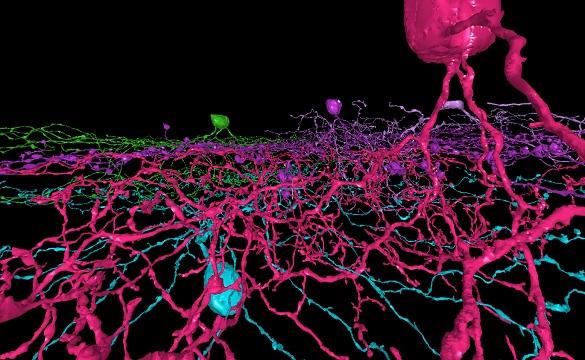
Computational modeling of neurons and neural networks is a rigorous scientific and mathematical discipline, and it's also a labor of love. It is "multi"-disciplinary in that it requires a working knowledge of biology, physics, mathematics, and engineering. To build a model, we'll need a neural network simulator, so we'll look at the state of the art in modeling and the tools that are available to us. (There is no perfect simulation engine, instead there's a collection of tools tailored for specific purposes, and we have to export and import information between them - which is not always possible!)
In this section we'll apply what we've learned. We'll raise a computational model of the visual and oculomotor parts of the brain, from the ground up. We will necessarily be using biologically compatible models, and we'll need to keep them computationally friendly. In the course of this discussion, we'll introduce several of the current modeling tools, and discuss their strengths and weaknesses. These include the popular model-wares called Brian2, Nengo, NEURON, and Nest, which together are representative of the state of the art. Additionally we'll be exploring the workflows involved in modeling, and looking at the places where information interchange is important. |